
The Battle of Waterloo was fought on Sunday 18 June 1815 near the village of Waterloo in Belgium. Two large forces under Wellington and Field Marshal Gebhard von Blücher assembled close to the north eastern border of France. Napoleon attacked first in the hope of dividing and destroying them before they could join in a coordinated invasion of France with other members of the Coalition. Can you change the outcome for either force?
Category: Events
So the first day at Salamanca has been a success for the British, the French began their day historically with three divisions strung out on front of the ridge to the east of the Lesser Arapile. In addition to these they had a light Cavalry division as well as Boyers Heavy cavalry division supporting them. To the North east of these there are a further three divisions along with a light cavalry division. The British and Spanish were deployed inside this imaginary “L” shape, with the Guards division under Campbell at the apex of the “L”.
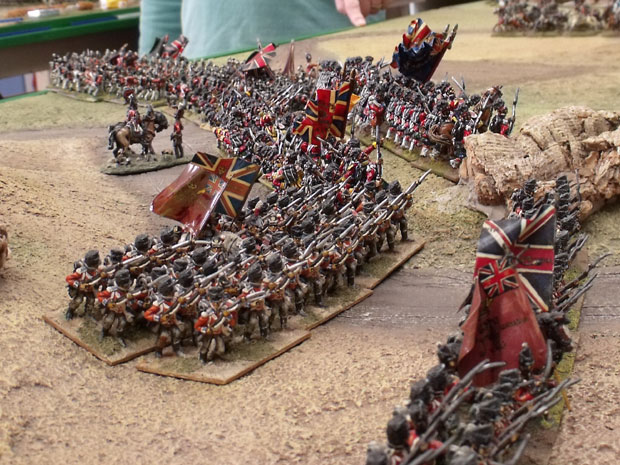
British Guards Battalion advancing to meet the French threat.
Right from the off the French were very aggressive, assaulting the apex of the “L” shape of the British Line. In contrast the British defended the ridge doggedly with the British Guards division advancing in to the teeth of the advancing French divisions and dealing out a severe drubbing to the enemy. The first Battalion of British Foot Guard withstood shot and shell for eight turns, finally retreating once they were down to two figures. Once they had fallen back the supporting battalion were charged by a squadron of dragoons that had anticipated an easy victory over the unformed/pinned Guardsmen, however the resulting volley still took seven of the eight Dragoons out, very nearly killing Boyer!!
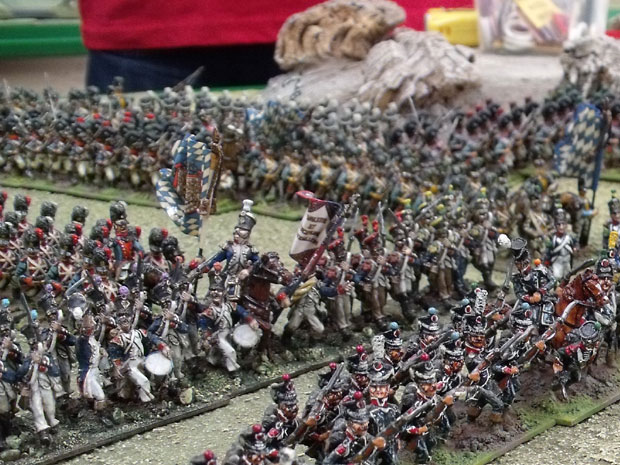
The French Divisions advance into the British firing lines!
The highland Brigade stood shoulder to shoulder with their English counterparts and meted out vicious retribution to the French men assaulting their position, these like the Guardsmen gave their ground only at the cost of Frenchmen. Finally below firty percent they retired behind the ridge of the Lesser Arapile to regroup and move to support the other Highland battalion now firing into the French mass.

The British Light division engages the battery of Maucune’s division!
Over on the North East of the battlefield the stream separating the French from the British Divisions was duelled over, the Light Division engaging the French artillery and supporting battalions at close range. After nine turns the supporting division of Pakenham is now manoeuvring into position to attack the French to the east of the Lesser Arapile. Leith’s Division is making it’s way forward, clearing the small out buildings west of the dried riverbed. Aiming to stop the attempted French outflank to the North east of the British position.
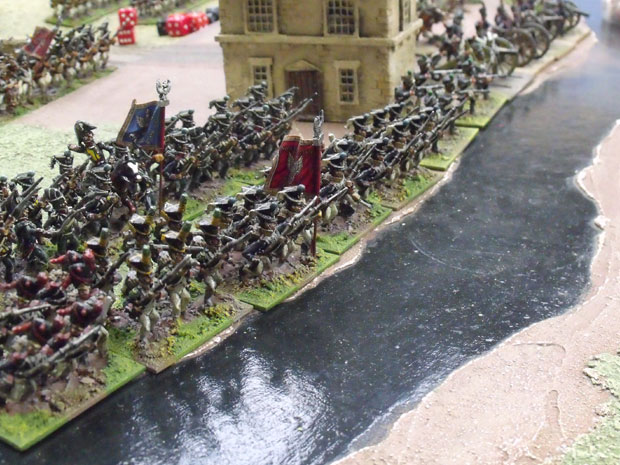
The recipients of the British Light divisions attentions, some veteran Polish troops.
At the western end of the ridge, the British Divisions along with the Spanish Division of De Espana are holding the Allied right flank. An earlier attempt by a French Light Cavalry Division to outflank their position being scuppered after some initial successes. The British light cavalry buying time enough for the Spanish to anchor the far right of the ridge and hopefully securing the wing.
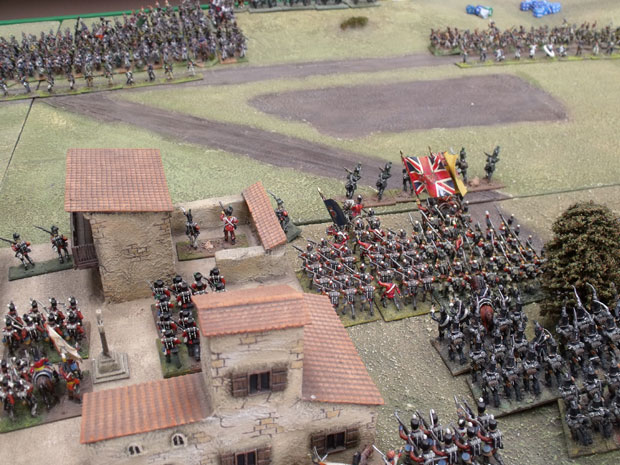
The fight over Los Arapiles begins!
The French Division outside the village of Los Arapiles is suffering casualties but holding it’s ground, while another pushes passed to assault the main ridge, where the British Divisions of Hope and Clinton have pushed forward to the front of the ridge to better engage the advancing French masses.
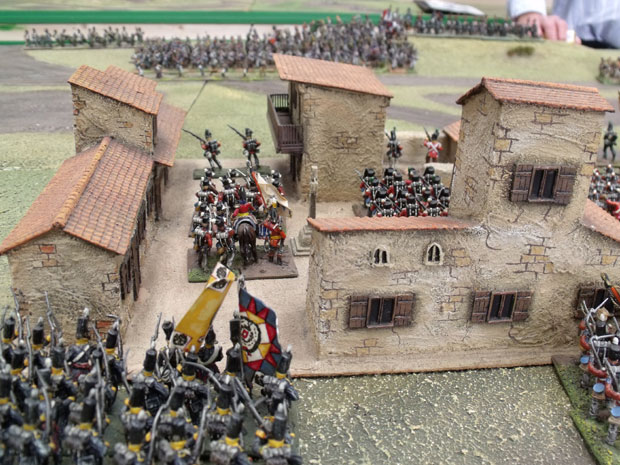
Outside Los Arapiles the punishment begins!
The battle still hangs in the balance, a lot to be played for….tomorrow is, as they say another day!
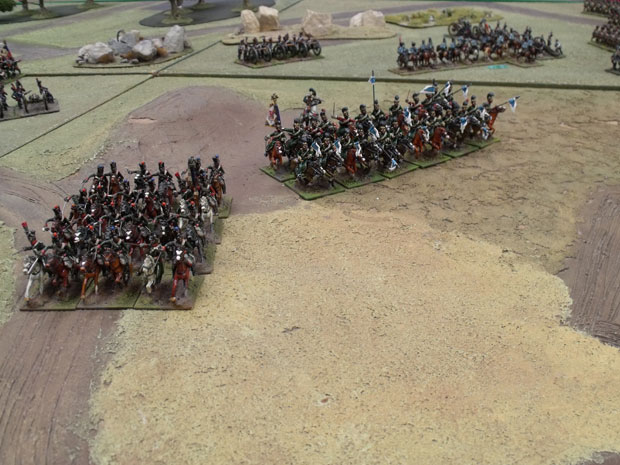
Two cavalry regiments from Soult’s cavalry division.
More tomorrow!
Play testing the Flames of War proved to be a breeze, we made some amendments along the way. We decided that the aircraft needed a little something, so we decided that when a flight arrived from the Germans, we rolled to intercept as normal.
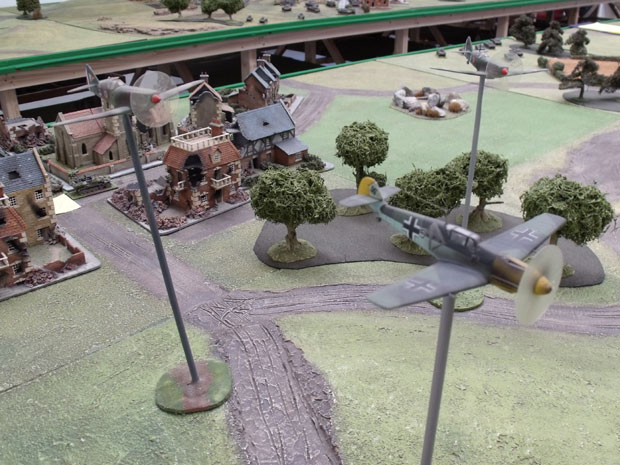
Here is an example of two French Fighters turning up to engage two German aircraft.
(You’ll notice from the photos that there are German fighters in the ground attack, this was some poetic licence on our part, they all performed as if they were Stukas for the ground attack, it just gaveus an excellent opportunity to mix the two for the pictures!)

Here is an example of two Spitfires patrolling after shooting down a lone Stuka flight.
If there was an interception this was then rolled as if it was a flight attacking, so the aircraft dice were rolled, the result being one to three interception aircraft.
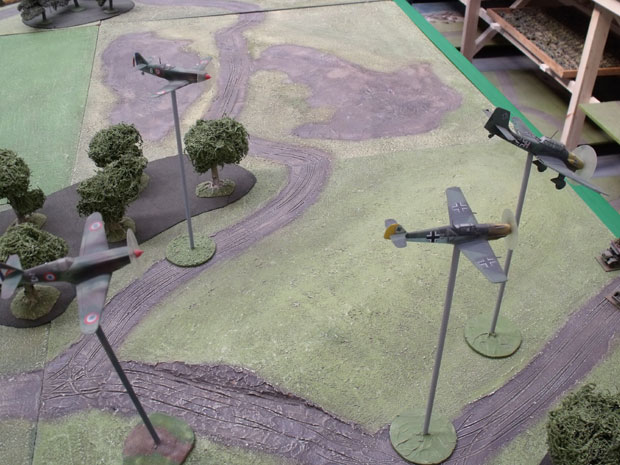
Two French fighters look to intercept a German Flight on ground attack.
The Allied player then rolled to hit using the skill of the air support, then a fire power test to finally destroy an enemy plane. So two planes arrive, two dice for the allies needing a 4+. Any hits were then converted to kills on a successful fire power test.
This reduced the number of German planes attempting the bombing run.
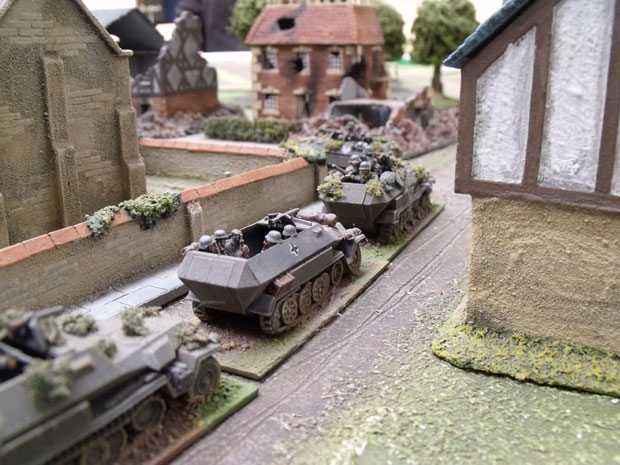
German Gepanzerte troops move into a French village.
We also looked at Morale, one of the challenges for a game running for over two days is the fact that units may literally disappear when they are sufficiently damaged. This was diluted somewhat with a rule offering that any unit requiring a morale test would test as normal.
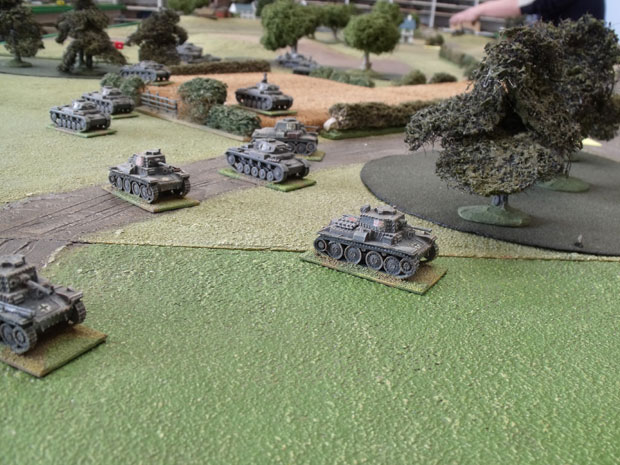
German Panzer division counterattacking.
If there was a failure, the unit would double away in rout from the enemy causing the test.
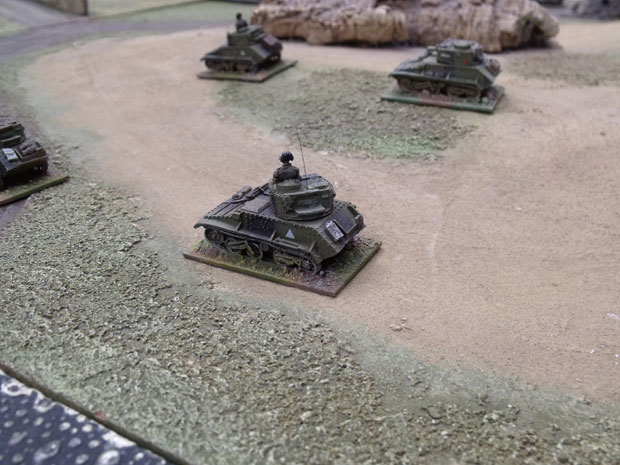
Mk Vi Vickers scouting ahead.
As this is doubling, all rules for doubling would apply. Senior commands to the unit routing could then rally the unit in the morale phase of the turn in which they had routed, routs being conducted immediately and rallies being in the following “start” step. If the unit rallied infantry would then go to “pinned”, armour would go to “Bailed out”.
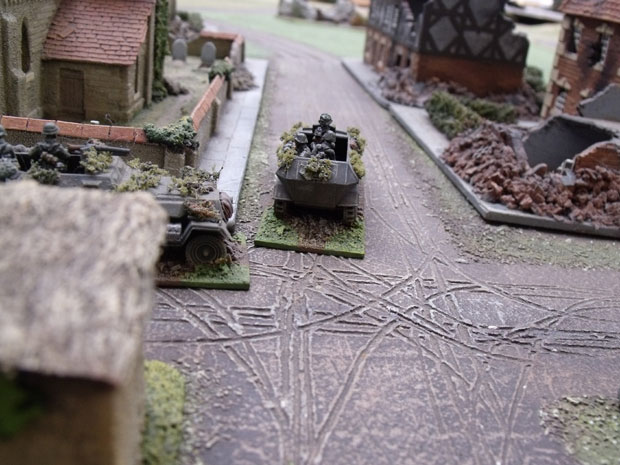
German infantry attached to 7th Panzer division moving into position.
More to come!
I have just got back from the Wargames Holiday Centres play test for our WWII collection. We have a weekend for France 1940 coming up in June and needed to get to grips with our spin on the Flames of War rules. In order for us to have these work over a weekend playing one of our huge battles, I needed to play test things. So we set up a fictional part of the battlefield, devised army lists for the French, British and Germans and let fly.
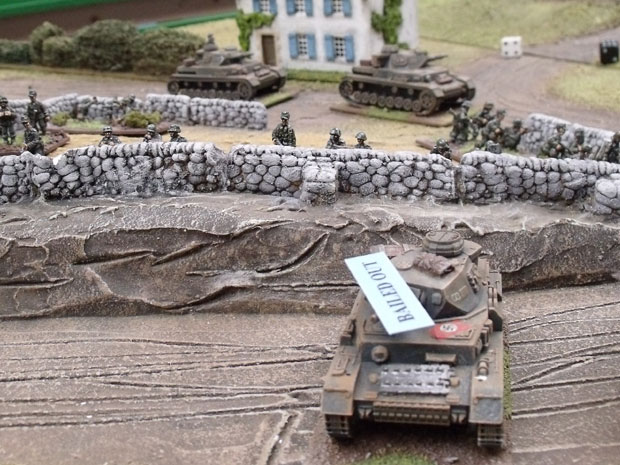
German infantry supporting, bailed out Panzer IV.
The results were exceptionally good, I admit we have tweaked the rules a little to allow us to maintain playability with some huge forces, failure of morale did not see units disappear. It did however see them doubling back toward their own lines.
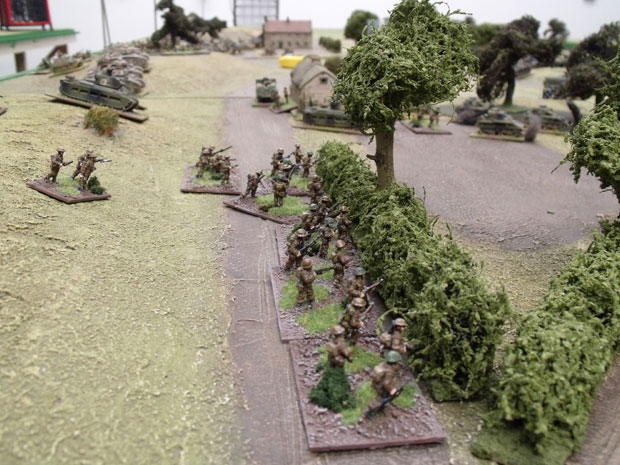
British Infantry in cover.
We allowed rallying if a superior command from their formation was within range as well. This mean’t that units could fall back and have some possibility of staying on the table, albeit at half strength.
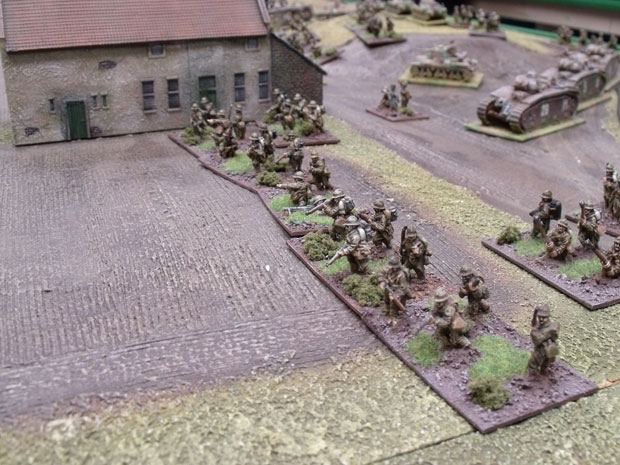
French infantry advancing into the fray.
It’s been a long weekend though, so more on this in the week!

Matilda Seniors with a burnt out MK VI
Starting with a two day Napoleonic Battle, then a day of Battle on the U.S. Plains with Pony Wars, followed by an ACW battle and finally a Marlburian battle.
Loads of variety and great value, these have proved popular with our regular clients, so book early to avoid disappointment.
FATHERS AND SONS. – I WANTED TO OFFER A SPECIAL TO ALL THOSE FATHERS WANTING TO GET A GAME IN WITH THEIR SON. ON THIS WEEKEND ALL SONS WILL HAVE A FREE PASS TO THE WARGAMES HOLIDAY CENTRE. SO A 2 FOR THE PRICE OF 1 OFFER!!
Battle of Austerlitz, 2 December 1805, also known as the Battle of the Three Emperors! Napoleons finest victory, where the French destroyed the Third Coalition.
Take up the Sword as Bessieres and thunder through the Russian lines with the Imperial Guard cavalry, or defend the heights with Kollowrat and his Austrians!