
Over a long weekend a bunch of avid gamers got together here at the Wargames Holiday Centre to play out the largest battle of the Napoleonic War, Leipzig. The battle has so many troops on the table that it takes three days, not the usual two, to play it.
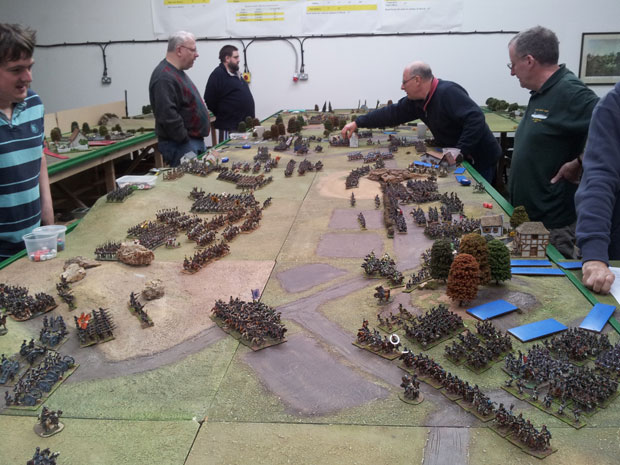
Some of the Players on the southern front during the opening stages of the battle.
The Battle takes on a new concept of the gaming experience as well, here at the WHC we have two tables 6′ wide and 28′ long, along with a 3′ table again 28′ long. Now to move figures and reach them all these tables have three foot gaps between them, allowing the placement of a board in the gap, if needed. Of course the gaps don’t exist in theory, so they butt up against the next board on the other table, leaving no gaps perceptibly. Well at Leipzig we physically fill the middle gap with a number of boards, leaving a twelve foot by three foot gap that is the city of Leipzig. The French play in this gap and are effectively surrounded by the Allies.
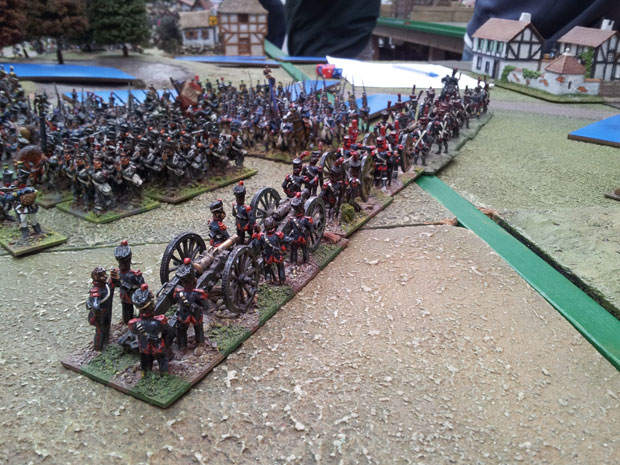
A horse battery from Sebastiani's Corps leading Victors foot battery to the deployment area..
You’ll note the edges of the table here, where the board has been inserted to remove the gap.
Reinforcements arrive throughout the first day of battle, 16th October historically, with more turning up on the third day, the 18th October.
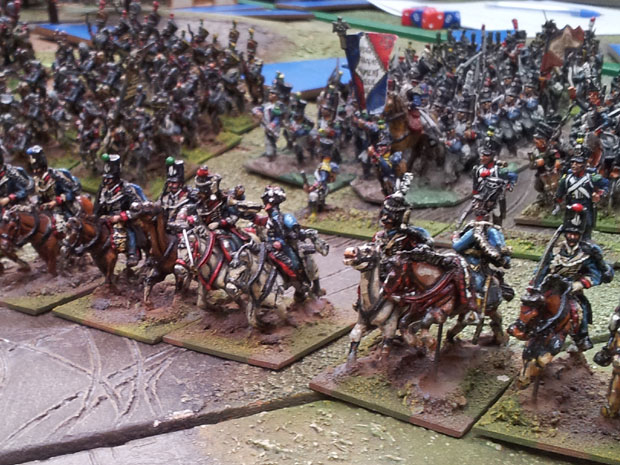
French Light Cavalry from Victors Corps.
For our games there were ten players, so five a side. The Army of Bohemia starts south and south west of Leipzig, the Army of Silesia to the north west, the Army of the North is marching in from the North east and the Army of Poland coming in from the south east to support the Army of Bohemia. The French have Macdonald, Reynier and Delmas’s division of III corps arriving from the North.
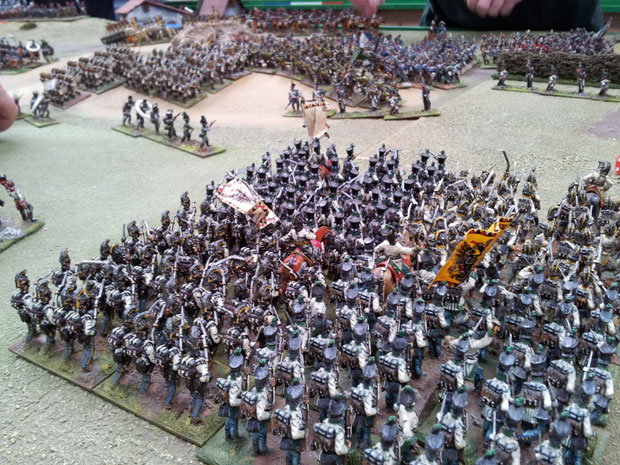
The Austrian Corps of Klenau's command advance into a hail of fire.
The opening phase of the battle was particularly aggressive, the Austrian IV Corps under the command of Klenau immediately advanced on the village of Zuckelhausen to the south east of Leipzig, while the centre opened up with batteries of artillery on the southern defences of Leipzig. Gyulai’s Corps advanced toward Markranstdat and Lindenau with the aim of cutting off the French withdrawal to the west. Over in the North east, Blucher’s army of Silesia advanced toward the village of Mockern, two Russian Corps were marching in to support the Prussian Corps of Yorck.
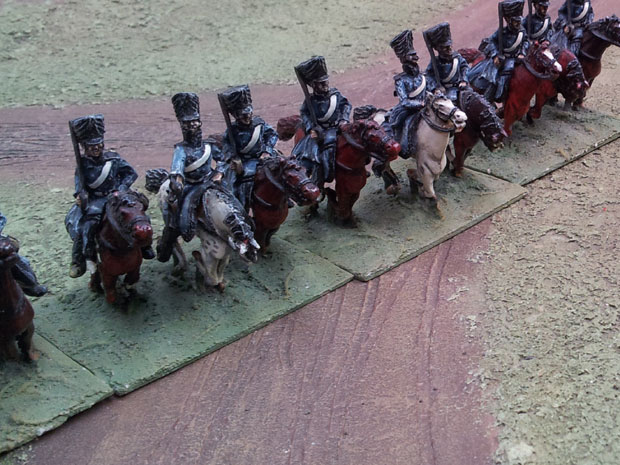
Prussian Dragoons from Kleist's Corps move out to engage Sebastiani's Cavalry.
The French opened up their side of the engagement in true French fashion and attacked toward these Corps. Victors Corps along with Sebastiani launched an aggressive attack back toward Lieberwolkwitz to the south-east of Leipzig, while Marmont (II Corps)and Souham (III Corps) attacked Blucher and Yorck to the North-East.
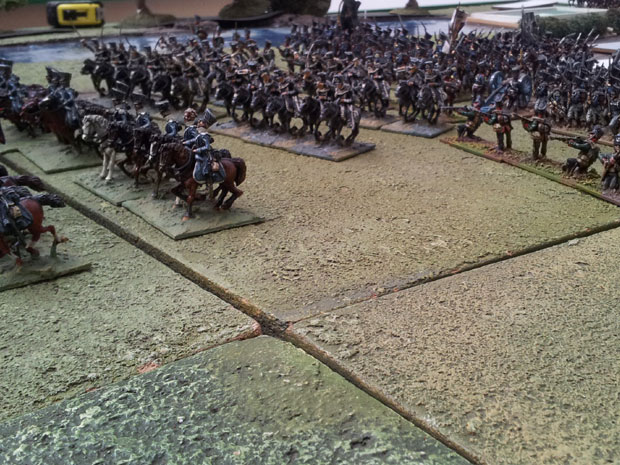
Prussian troops under Yorck advance toward Mockern.
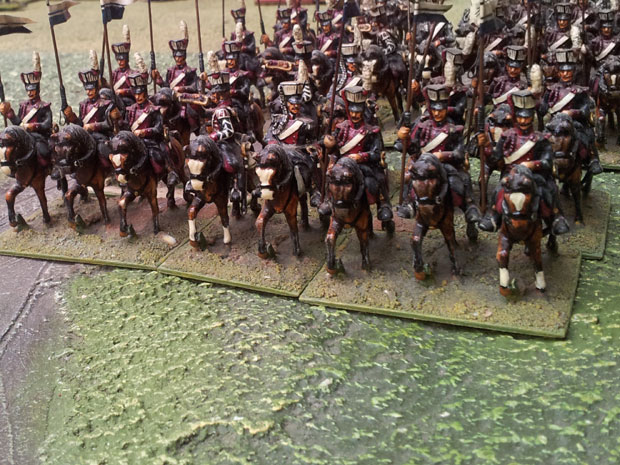
Russian Uhlans under the orders of Yorck advance to engage the forces of Souham's III Corps..
In the City of Leipzig the French reserve heavy cavalry of Latour Maubourg (I Cav. Corps) moved North east to support Marmont, Pajol (V Reserve Cav. Corps) and Souham in their attack.
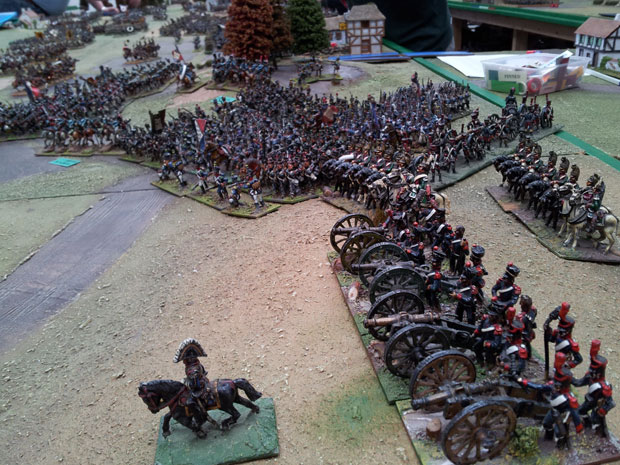
French horse battery being deployed under the watchful eye of Sebastiani..
The attack by Sebastiani and Victor hit the Prussians of Kleist’s Corps and a large cavalry melee ensued. Victor pushed toward the village of Lieberwolkwitz. Kleust rushed his Landwehr in to the village and supported the position with his twelve pounder battery. Further to the west on the southern front Klenau baga to take casualties from the batteries of Lauriston and Augerau, the huge Austrian battalions easily soaking up the damage initially.
Half way through the morning the Austrian reserve under Hessen Homburg arrived and pushed toward Cracowitz on the eastern bank of the river Pleisse. The village and surrounding area had just recently been occupied by Poniatowski’s Polish Corps, who were fortifying the position.
Further to the west between the rivers Pleisse and Elster, the Austrian Corps under Meerveldt was navigating it’s way slowly through the open woodland toward Cracowitz. Gyulai was marching to cut off the causeway near Lindenau.
The French moved the Westpahalian Observation Corps out toward the causeway to keep this route open.
More tomorrow!